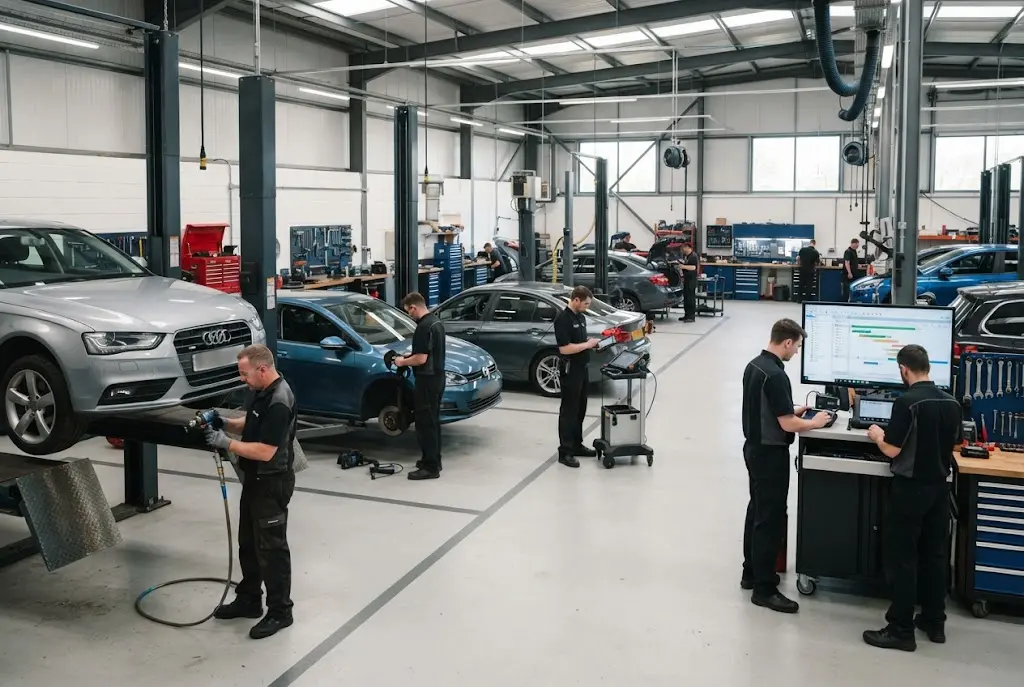
Effective vehicle maintenance is about more than keeping cars roadworthy. For an automotive business, the way maintenance work is scheduled, diagnosed, completed and quality-checked can have a direct effect on productivity, customer satisfaction and profitability. When workshops improve their operational processes, they can often serve more customers without simply adding more bays, staff or equipment.
This makes service operations a critical part of running a profitable garage. Strong workflows reduce avoidable delays, help technicians spend more time on productive work and create a more consistent customer experience. For UK workshops, the opportunity is particularly important as customers expect reliable servicing while vehicles and their maintenance requirements continue to become more technically complex.
Why Vehicle Maintenance Workflows Matter
A workshop can have skilled technicians and modern equipment yet still lose efficiency if vehicles move poorly through the operation. A car may arrive on time but wait for an inspection. A technician may identify a repair but have to wait for customer authorisation. Approved work may then be delayed because a required part has not arrived.
Each delay can reduce workshop capacity.
A clear maintenance workflow connects the main stages of the customer and vehicle journey. Depending on the business, this can include booking, vehicle reception, inspection, diagnosis, quotation, authorisation, parts allocation, repair, quality control, invoicing and collection.
The objective is not to make every job identical. Different vehicles and repairs naturally require different processes. Instead, the workshop should establish a dependable operating framework that allows staff to handle variations without losing control of the overall workflow.
Map the Complete Maintenance Process
The first step towards operational improvement is understanding how work currently moves through the workshop.
Management should examine what happens from the moment a customer books an appointment until the vehicle leaves the site. This can reveal bottlenecks that are easy to overlook during a busy working day.
Useful questions include:
- Are bookings matched to realistic workshop capacity?
- Are technicians receiving the information they need before starting a job?
- How long do vehicles wait before inspection?
- How quickly are diagnostic findings communicated?
- How long does customer authorisation take?
- Are parts available when technicians need them?
- Are completed vehicles waiting unnecessarily for collection?
- Are quality checks consistently completed?
These questions turn a general concern about efficiency into specific operational problems that can be measured and addressed.
Businesses that already operate multiple locations can also use these processes to create more consistent standards. The previous article on scaling multi-location automotive businesses explored how repeatable systems can support workshop networks as they grow.
Improve Technician Scheduling
Technician time is one of the most important resources in a workshop. Poor scheduling can leave some technicians overloaded while others have gaps between jobs.
Effective technician scheduling should consider the estimated labour time, technician skills, job complexity, equipment requirements and promised completion time. A routine maintenance job may be suitable for a wider range of technicians, while advanced diagnostics or specialist repairs may require particular expertise.
Scheduling should therefore be based on capability rather than simply assigning the next available person.
Digital workshop management systems can make this easier by providing visibility of appointments, job status and technician availability. However, technology alone does not solve scheduling problems. Management still needs realistic labour estimates and accurate information about technician capability.
When schedules are built around realistic capacity, businesses can reduce rushed work, unnecessary overtime and periods of unused workshop capacity.
Increase Workshop Utilisation Without Sacrificing Quality
Workshop utilisation is an important operational measure, but it should not be treated as a target that encourages technicians to work faster at the expense of quality.
A productive workshop uses available labour and equipment efficiently while maintaining appropriate inspection and quality standards.
Low utilisation may indicate insufficient demand, poor booking practices, excessive vehicle waiting time or inefficient job allocation. High utilisation can also create problems if the workshop consistently accepts more work than it can complete reliably.
The aim is therefore balanced utilisation. Managers need enough flexibility to deal with unexpected repairs and diagnostic complications without allowing the daily schedule to become unmanageable.
This is where process improvement can make a meaningful difference. Removing avoidable waiting time can increase productive capacity without requiring the business to physically expand.
Separate Productive Work From Workshop Delays
One of the most useful operational exercises is to identify why vehicles are waiting.
A vehicle may occupy a bay while technicians are waiting for:
- Customer approval
- Diagnostic information
- Parts
- Specialist equipment
- Technical support
- Another department
- Vehicle collection
These delays have different causes and therefore require different solutions.
If customer approval is consistently slow, clearer digital communication may help. If parts availability is the problem, purchasing and stock management may need attention. The If technicians frequently wait for specialist equipment, workshop scheduling may need to change.
Simply telling employees to work faster rarely addresses the underlying issue.
Strengthen Preventive Maintenance Processes
Preventive maintenance is another area where good operational systems can benefit both customers and workshops. Identifying developing issues during appropriate inspections can allow customers to plan repairs before a problem becomes more disruptive.
However, recommendations should be based on the actual condition of the vehicle and relevant servicing requirements. A professional maintenance process should distinguish between work that requires immediate attention and items that can reasonably be monitored or planned for later.
This approach helps build customer confidence because recommendations are presented as useful maintenance information rather than a list of sales opportunities.
It also supports better workshop planning. When future maintenance requirements are recorded accurately, the business can potentially anticipate upcoming work rather than relying entirely on unexpected repair demand.
Customer communication is an important part of this process. The previous article on building customer loyalty through car servicing explains how service records, reminders and maintenance plans can help turn individual visits into longer-term customer relationships.
Standardise Vehicle Inspection Procedures
Consistent inspection procedures help reduce variation between technicians and make customer communication easier.
A workshop can establish appropriate inspection points for different types of servicing or maintenance work. Technicians should then record relevant findings clearly so that service advisers can explain them to customers accurately.
Photographs, digital inspection reports and structured notes can be useful where the business has the systems and processes to support them.
The objective is not to create unnecessary administration. Inspection information should help three groups:
- Technicians, by providing a clear record of findings and required work.
- Service advisers, by making customer communication more accurate.
- Customers, by giving them understandable information about their vehicle.
When these three areas work together, the workshop can make decisions more efficiently while improving transparency.
Manage Parts Before They Become Bottlenecks
Parts availability can have a major impact on workshop productivity. A technician may complete diagnosis quickly, but the vehicle can remain unavailable for collection because a required component has not arrived.
Businesses should therefore pay attention to parts ordering, supplier reliability, stock levels and communication between service advisers and technicians.
Not every workshop needs to hold large quantities of inventory. The right approach depends on the type of vehicles serviced, job volume, supplier lead times and the cost of carrying stock.
However, recurring delays should be analysed rather than accepted as an unavoidable part of workshop life.
Where a particular component is frequently required, better forecasting or supplier arrangements may reduce waiting time. For less common parts, communicating realistic completion times to customers can prevent unnecessary dissatisfaction.
Use Quality Control to Reduce Repeat Work
Operational efficiency is not simply about completing more jobs. A vehicle that returns because an issue was not resolved correctly creates additional labour, consumes workshop capacity and can damage customer trust.
Quality control should therefore form part of the maintenance workflow.
Depending on the job, this may involve checking completed work, confirming that relevant components have been fitted correctly, reviewing diagnostic information or carrying out an appropriate final inspection.
Businesses should also track repeat faults and comebacks. A high number of repeat visits for the same issue may indicate a training requirement, process weakness, parts problem or diagnostic challenge.
Reducing repeat work can improve both service quality and workshop profitability because the business avoids using productive capacity to correct preventable mistakes.
Measure Operational Efficiency With Useful KPIs
Workshop managers need reliable information to understand whether process improvements are actually working.
Useful operational measures can include:
- Technician productivity
- Labour utilisation
- Average job completion time
- Vehicle turnaround time
- First-time fix rate
- Repeat repair or comeback rate
- Parts-related delays
- Customer waiting time
- Number of completed jobs
- Average labour value per job
The most useful KPIs depend on the workshop’s business model. A specialist repair centre may have longer jobs than a fast-turnaround servicing operation, so direct comparisons can be misleading.
Managers should instead establish realistic benchmarks for their own operation and track trends over time.
Turn Data Into Process Improvement
Collecting operational data has little value if nobody uses it to make decisions.
Suppose a workshop discovers that vehicles frequently remain in bays for several hours after work has been completed. The issue may not be technician productivity at all. It could be caused by delayed customer collection or inefficient communication.
Similarly, if technicians consistently complete jobs faster than the booking system predicts, management may be able to improve scheduling accuracy and use available capacity more effectively.
Process improvement should therefore follow a simple cycle: measure the current situation, identify the constraint, test an improvement, monitor the result and standardise the change if it works.
This approach is generally more reliable than introducing several changes at once without measuring their individual effects.
Protect Service Quality During Growth
Operational efficiency should support customer experience rather than undermine it.
When workshops become busy, there can be pressure to increase throughput by reducing inspection time, rushing customer communication or accepting more vehicles than the team can realistically handle. These decisions may create short-term revenue but can damage long-term profitability if they result in complaints, rework or lost customers.
Strong service operations balance capacity with quality.
This is particularly important for growing businesses. If additional locations are eventually added, each branch needs processes that can maintain the expected standard without depending on constant intervention from the owner or senior management.
Build Maintenance Workflows Around the Customer Journey
The best operational systems connect workshop efficiency with customer expectations.
A customer does not see technician utilisation or internal scheduling data. They experience whether the booking was convenient, whether the vehicle was ready when promised, whether additional work was explained clearly and whether the completed maintenance met expectations.
For that reason, every internal process should ultimately support a better customer journey.
A well-managed workflow can give technicians the information they need, help service advisers communicate accurately and provide customers with realistic expectations. When these functions work together, the business can improve efficiency without making the experience feel rushed.
Prepare Teams for More Complex Vehicle Maintenance
Vehicle technology continues to change the skills, equipment and processes required by automotive businesses. Electric vehicles, advanced driver assistance systems and increasingly sophisticated onboard electronics can require appropriate training and diagnostic capability.
SMMT has highlighted the importance of investment in training, tools and talent as UK workshops adapt to newer vehicle technologies. ([smmt.co.uk](https://www.smmt.co.uk/workshops-invest-in-tech-and-talent-to-keep-britains-safer-greener-cars-on-the-move/?utm_source=chatgpt.com))
This means operational planning should include workforce development. A workshop may have excellent processes, but those processes must be supported by technicians with the skills required for the vehicles entering the bays.
Businesses should therefore consider training requirements when reviewing future workload, equipment purchases and service offerings.
Improve Profitability Before Adding More Capacity
When demand increases, the obvious response may be to hire more technicians, extend opening hours or open another location. Sometimes those steps are appropriate. However, management should first determine whether existing capacity is being used efficiently.
If workshop bays are occupied by vehicles waiting for parts or authorisation, additional space may not solve the real problem. If technicians spend too much time on avoidable administrative tasks, additional recruitment may simply increase costs without addressing workflow weaknesses.
Improving the existing operation can therefore be a valuable step before committing to major expansion.
The objective is not to maximise every minute of every working day. It is to create a predictable operation in which people, vehicles, equipment and information move through the workshop efficiently.
Connect Operations With Pricing and Profit Margins
Operational efficiency and pricing strategy are closely connected. A business needs to understand its labour costs, parts costs, workshop capacity and service quality when deciding how to price maintenance work.
If a job consistently takes longer than expected, the problem could be an inaccurate labour estimate, an inefficient workflow or an issue with technician capability. Simply increasing the price may not solve the underlying operational problem.
Conversely, an efficient workshop may be able to deliver competitive pricing while maintaining appropriate margins.
The next commercial consideration in this cluster is winning on price without losing profit, where service pricing, maintenance packages and profitability are examined in more detail.
Make Operational Efficiency a Continuous Process
There is rarely a point at which a workshop can declare its processes completely optimised. Customer expectations change, vehicle technology develops, staffing changes and demand fluctuates.
Successful service operations therefore treat improvement as an ongoing management discipline.
Regular reviews can identify recurring delays, quality issues, training needs and opportunities to improve scheduling. Managers can then prioritise the changes that are most likely to affect customer experience, workshop capacity or profitability.
For an automotive business, the strongest operating model is one where every stage of the process has a clear purpose. Bookings should reflect real capacity. Technicians should have the information and equipment they need. Parts should arrive when required. Customers should receive clear updates. Completed vehicles should pass appropriate quality checks before collection.
When these elements work together, vehicle maintenance becomes more than a technical service. It becomes a structured business operation capable of generating reliable customer value while using labour, equipment and workshop space more effectively.
That combination is what allows a garage to improve profitability without compromising service quality. It also creates a stronger foundation for managing larger teams, which is the next important operational challenge for growing automotive businesses.
For garages seeking to strengthen that area, the next cluster topic explores managing automotive repair teams, including technician productivity, staffing, repair workflows and operational leadership.
For UK businesses involved in MOT testing, operational processes should also remain aligned with current regulatory requirements. The official GOV.UK guidance on MOT testing station requirements provides information on the standards and conditions applicable to authorised testing stations.