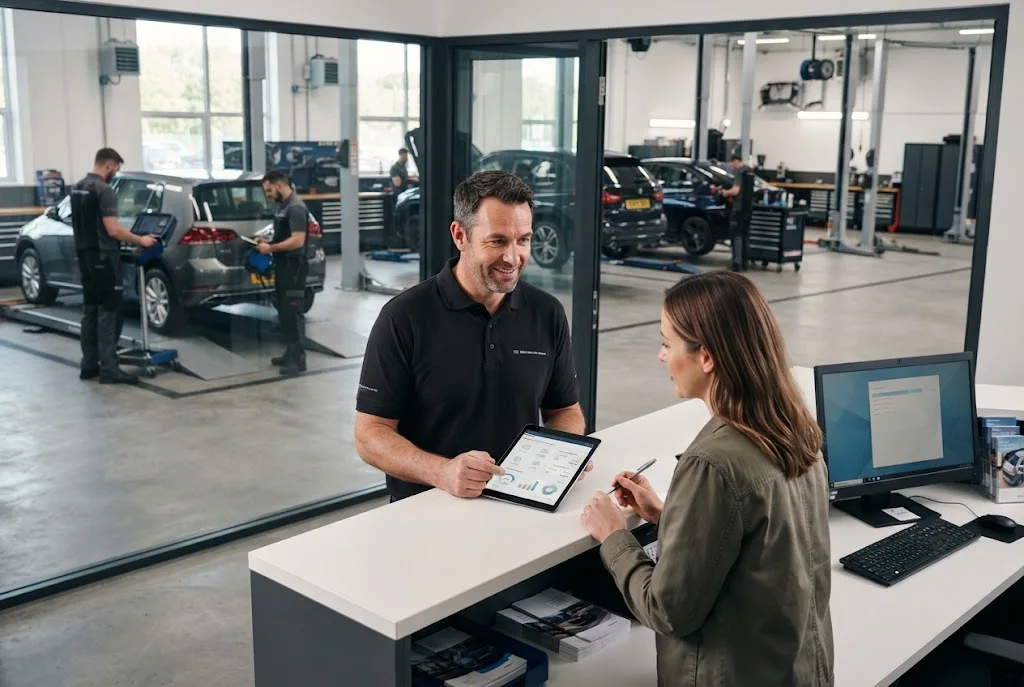
Managing car service cost is one of the most important commercial challenges for an automotive business. Customers naturally compare service and repair prices, but a garage cannot build a sustainable business by simply becoming the cheapest option in its market. The stronger approach is to create a pricing strategy that reflects labour, parts, workshop capacity, service quality and customer value while remaining competitive.
For UK garages, pricing decisions also need to be transparent. Current Competition and Markets Authority guidance says businesses must provide clear, complete and accurate pricing information and include unavoidable charges in the total price presented to consumers. This makes pricing both a commercial issue and an important part of customer trust.
Why Car Service Cost Is More Than the Price on the Invoice
A customer’s final bill represents only part of the economics behind a workshop job. The business also needs to cover technician wages, premises, equipment, diagnostic tools, insurance, administration, utilities, software, parts handling, training and other operating expenses.
Two garages can therefore charge different prices for apparently similar work and still have completely different profit margins.
A workshop with higher operating costs may need a higher labour rate to remain profitable. Another garage with a different cost structure may be able to offer a lower price while maintaining an acceptable return.
This is why automotive businesses should understand their own cost base before attempting to match a competitor’s price.
Calculate the Real Cost of Providing a Service
The first step in developing a sustainable pricing model is understanding what each job actually costs the business.
Relevant costs can include:
- Technician labour
- Parts and consumables
- Workshop overhead
- Diagnostic equipment
- Specialist tooling
- Waste disposal
- Administrative labour
- Payment processing
- Warranty or comeback costs
- Training and technical information
Some costs are directly connected to individual jobs, while others are overheads that need to be recovered across the workshop’s overall workload.
Understanding this distinction allows management to calculate whether a service is genuinely profitable rather than assuming that revenue automatically equals profit.
Do Not Build a Pricing Strategy Around Competitors Alone
Competitive pricing matters, but copying another garage’s price without understanding its business model can be dangerous.
A competitor may have different premises, supplier agreements, staffing costs, equipment investments or customer volumes. It may also be using a low introductory price to attract customers and make money through additional services.
Before changing prices, a garage should therefore ask:
- What does this job cost us to deliver?
- What margin do we need?
- What value does the service provide?
- How does our service compare with local alternatives?
- Are customers comparing genuinely like-for-like services?
- Can operational improvements reduce our underlying cost?
This approach creates a more informed pricing strategy than simply trying to advertise the lowest number.
Use Clear Service Pricing Models
Different automotive services may benefit from different pricing models.
A garage might use fixed prices for clearly defined servicing packages, hourly labour rates for repairs where the scope is uncertain, or quoted prices for specific diagnostic and repair jobs.
The important issue is clarity.
Customers should understand what a quoted service includes and what may cause the price to change. If additional work is discovered during an inspection, the garage should communicate the finding and obtain appropriate approval before carrying out chargeable additional work.
This protects both the customer relationship and the workshop’s commercial position.
Make Pricing Transparent From the Start
Price transparency has become an increasingly important issue for UK businesses. The CMA’s January 2026 guidance states that consumers should receive the information they need to make informed decisions and compare competing offers. It also says unavoidable fees and charges should normally be included in the total price rather than revealed later.
For an automotive business, this means a headline service price should not create a misleading impression about what the customer will ultimately pay.
If a price depends on variables that cannot reasonably be known in advance, the business should explain how the final price will be calculated.
Clear pricing can actually strengthen competitiveness. Customers are more likely to trust a garage that explains its charges than one that advertises an unusually low starting price and introduces additional costs later.
The CMA’s wider price-transparency guidance specifically covers practices such as drip pricing and partitioned pricing, making it useful for businesses reviewing how service prices are presented online.
Offer Maintenance Packages Without Destroying Margins
Maintenance packages can make pricing easier for customers to understand while creating opportunities for garages to improve average customer value.
A package might combine appropriate servicing tasks or offer different levels of maintenance based on vehicle requirements. The exact structure should depend on the garage’s capabilities and customer base.
However, packages should not simply bundle unnecessary work together to make the headline price appear more attractive.
A good maintenance package should be easy to understand and commercially sustainable. Management should know exactly what each package costs to deliver and what margin remains after labour, parts and other relevant expenses.
Packages can also help customers compare options. A basic service, for example, can be positioned differently from a more comprehensive maintenance option without forcing every customer into the highest-priced choice.
Separate Value From Cheap Pricing
Being competitive does not always mean being the cheapest.
A garage may justify a stronger price through convenient booking, experienced technicians, transparent digital inspections, quality parts, specialist diagnostic capability, strong customer communication or dependable after-sales support.
Customers may be willing to pay more when they understand what they are receiving in return.
This is especially relevant for specialist automotive businesses. A workshop with expertise in a particular vehicle type or advanced technology may be competing on capability rather than simply on hourly labour price.
The business therefore needs to communicate its value clearly.
Understand Labour Pricing and Technician Capacity
Labour pricing is one of the most important elements of workshop profitability.
A technician may be employed for a full working day, but not every paid hour will necessarily become chargeable productive work. Time can be lost through vehicle movement, preparation, diagnostics, waiting for parts, customer approvals, cleaning, administration and other activities.
This means the labour rate needs to reflect realistic productive capacity rather than simply the employee’s wage.
The previous article on managing automotive repair teams explored technician productivity, staffing and repair workflows. Improving those areas can sometimes have a greater effect on profitability than simply increasing customer prices.
If a workshop improves productive utilisation, it may be able to maintain competitive customer pricing while generating a healthier return from the same physical capacity.
Improve Profit Margins Through Operational Efficiency
Pricing and operations cannot be separated.
If technicians regularly wait for parts, vehicles occupy bays unnecessarily or repair jobs require avoidable rework, the cost of delivering services increases. Raising prices may compensate for some of the additional cost, but it does not solve the operational problem.
A better approach is to improve the underlying process.
Effective vehicle maintenance service operations can reduce delays, improve scheduling and make better use of workshop capacity. When the business delivers work more efficiently, it can protect margins without automatically passing every inefficiency on to customers.
Use Different Pricing for Different Customer Needs
Not every customer values the same things. Some motorists prioritise price, while others value convenience, speed, specialist knowledge or a comprehensive maintenance experience.
A workshop can potentially address these differences through clearly differentiated service options rather than one universal offer.
For example, a business might provide a straightforward core service alongside a more comprehensive maintenance option. The distinction should be based on genuine differences in service scope and customer value.
This can create choice without relying on misleading discounts.
Be Careful With Discounts
Discounting can generate short-term demand, but frequent discounting can train customers to wait for promotions.
It can also make it difficult to understand the true profitability of the business.
Before launching a discount, management should calculate the effect on contribution margin and consider whether the additional volume is sufficient to justify the reduction in price.
There may be situations where a targeted offer makes commercial sense, such as filling quieter workshop periods or encouraging customers to book maintenance in advance. However, discounts should support a wider pricing strategy rather than replace one.
Use Maintenance Plans to Create Predictable Revenue
Maintenance plans can also play a role in profitability when they are designed around genuine customer needs.
A well-structured plan can make future maintenance more predictable for the customer and give the garage better visibility of expected workload.
However, the financial model needs to be tested carefully. The business should understand how many visits a customer is likely to make, what parts and labour may be required, and how changes in operating costs could affect the package.
Clear terms are essential. Customers should know exactly what the plan covers and what falls outside it.
This connects with the earlier cluster topic on building customer loyalty through car servicing, where maintenance plans, reminders and digital service histories were considered as tools for long-term customer retention.
Price Additional Repairs Responsibly
Additional repairs are common in automotive servicing because inspections can reveal issues that were not visible when the original appointment was booked.
However, additional work should be handled carefully.
The customer should receive an understandable explanation of what has been found, why the work may be required and what it is expected to cost. The garage should then obtain the customer’s appropriate approval before proceeding with additional chargeable work.
This approach protects trust and reduces disputes about unexpected bills.
UK consumer law also provides important protections around services. GOV.UK explains that services must be carried out with reasonable care and skill and, where no exact price has been agreed, for a reasonable charge.
The Consumer Rights Act 2015 similarly provides that where a service contract does not expressly fix a price or explain how it will be determined, the consumer is to pay a reasonable price.
Do Not Confuse High Prices With High Profit
A higher price does not automatically produce higher profitability.
If an increase causes customers to move elsewhere, workshop utilisation may fall. The business could then generate a higher margin per individual job while earning less overall.
Profitability depends on the relationship between price, demand, capacity and cost.
Management should therefore monitor both average invoice value and customer volume. If a price change affects booking rates, the business needs to understand why before making further changes.
Track the Right Pricing Metrics
Automotive businesses can use several measures to evaluate whether their pricing strategy is working.
- Average invoice value
- Labour revenue per productive hour
- Parts margin
- Gross margin per job
- Workshop utilisation
- Quote acceptance rate
- Average revenue per customer
- Repeat customer rate
- Discount usage
- Customer complaints relating to price
These measures become more useful when viewed together.
For example, an increase in average invoice value may appear positive until management discovers that quote acceptance and repeat bookings have fallen significantly. A more balanced analysis can reveal whether the pricing change actually improved the business.
Review Prices When Costs Change
Pricing should not be treated as a permanent decision. Labour costs, rent, equipment, parts, utilities, software and other operating expenses can change over time.
Regular reviews allow the business to identify whether current prices still support its required margins.
Price reviews should also consider customer expectations and local competition. A business may discover that some services are underpriced while others are already positioned appropriately.
Instead of applying the same percentage increase to every service, management can review individual service categories and make evidence-based adjustments.
Protect Trust When Prices Change
Customers may accept reasonable price changes when they are communicated clearly. Problems arise when a business appears to change prices unexpectedly or introduces charges that were not explained beforehand.
GOV.UK guidance on unfair consumer contracts warns that terms allowing businesses to increase agreed prices later can raise fairness concerns, particularly where customers were not given adequate information beforehand.
For automotive businesses, the practical lesson is simple: agree pricing clearly, explain variables where an exact price cannot be determined in advance, and avoid surprising customers with unavoidable charges.
Transparent pricing can become part of the brand rather than merely a compliance obligation.
Compete on Total Value, Not Just the Headline Price
A customer comparing two garages may initially focus on the advertised price, but the real comparison can involve much more.
They may also consider appointment availability, location, convenience, service quality, technician expertise, warranty or after-sales support, communication and confidence in the repair.
A garage should therefore communicate the total value of its service clearly.
This does not mean making exaggerated claims. It means explaining genuine differences between the business and its competitors.
For example, if a workshop invests in specialist diagnostic equipment and technician training, that capability may be relevant to customers whose vehicles require more advanced maintenance.
Make Pricing Part of the Wider Business Strategy
Pricing should connect with the entire operating model.
A growing business may need pricing that supports investment in additional technicians, equipment and locations. A specialist garage may need higher prices to support specialist training and diagnostic capability. A high-volume service centre may rely on efficient processes and competitive packages.
There is no universal pricing model that works for every automotive business.
The right strategy is the one that reflects the company’s costs, capabilities, customer proposition and growth objectives.
This also connects with the first topic in this cluster, scaling multi-location automotive businesses. A pricing model that works for one location may need additional controls and consistency when the business expands across a wider workshop network.
Build Profitability Without Sacrificing Customer Trust
The strongest automotive pricing strategies balance three objectives: remaining competitive, protecting appropriate margins and giving customers clear information.
Trying to win every customer through the lowest price can put unnecessary pressure on a workshop’s finances. At the other extreme, pricing significantly above the market without communicating genuine value can reduce demand.
A sustainable business finds the point where its service quality, operational efficiency and customer proposition support the price being charged.
That means understanding costs, measuring workshop performance, reviewing service packages and communicating prices transparently.
For businesses already improving their operations, this approach can create a positive cycle. Better workflows can reduce avoidable costs. Stronger teams can improve productivity and repair quality. Better customer retention can create more predictable demand. Clear pricing can then protect the margin needed to reinvest in the business.
Ultimately, car service cost should not be viewed as a race to the bottom. The objective is to offer a price that customers can understand and reasonably compare while ensuring the business earns enough to maintain skilled staff, quality equipment, reliable processes and sustainable profitability.
When pricing is connected to genuine value and efficient operations, a garage can compete effectively without sacrificing the financial health of the business. That is the foundation of a pricing strategy designed not just to win today’s booking, but to support long-term automotive business growth.
For workshops reviewing the full commercial model, pricing should now be considered alongside the cluster’s other operating priorities: customer loyalty through servicing, efficient service operations, effective repair teams and scalable multi-location operations. Together, these areas provide a stronger foundation for sustainable workshop profitability.