Understanding car service cost is essential for any garage that wants to remain competitive while protecting its profit margins. Customers naturally want a fair price for vehicle maintenance, but an automotive business must also cover technician labour, parts, equipment, premises and everyday operating expenses. The challenge is finding a pricing structure that provides genuine value without turning every service into a race to offer the lowest price.
For an independent workshop, pricing should therefore be based on the actual cost of delivering a service rather than simply copying a competitor’s price list. A professional approach considers the type of service, vehicle requirements, labour time, parts quality, workshop capacity and the value provided to the customer. When these factors are managed together, a garage can develop sustainable pricing while remaining attractive to its target market.
What Determines Car Service Cost?
There is no single price that applies to every vehicle service. The final cost depends on several variables, including the vehicle’s make and model, age, mileage, required maintenance, replacement parts and labour involved.
Even two vehicles receiving broadly similar maintenance may generate different costs because they use different parts or require different amounts of technician time. A workshop should therefore avoid relying entirely on one fixed price for every vehicle.
The main factors influencing car service cost include:
- Technician labour time
- Parts and consumables
- Vehicle type and specification
- Service level and inspection requirements
- Workshop overheads
- Diagnostic or specialist equipment
- Supplier and parts availability
- Additional faults discovered during inspection
Understanding these components gives business owners a stronger foundation for developing a realistic pricing strategy.
Calculate the Real Cost of Providing a Service
Before setting a customer-facing price, calculate what the service actually costs the business. Labour is an obvious component, but it is only one part of the calculation.
Workshop rent, electricity, insurance, equipment maintenance, software, waste disposal, administration and other overheads all need to be supported by revenue generated from completed jobs. If these costs are ignored, a service may appear profitable when its actual contribution is much lower.
Parts should also be accounted for accurately. A business needs to consider its purchase price, supplier terms, delivery costs where applicable and the time involved in sourcing or handling components.
The objective is not to make every individual job carry an identical percentage margin. Instead, the business should understand the overall economics of its service mix and ensure that pricing supports sustainable operations.
Average Car Service Cost and Customer Expectations
Customers often search for an average car service cost before contacting a garage. This means businesses need to understand how consumers perceive pricing, while recognising that an average figure cannot describe every vehicle or service package.
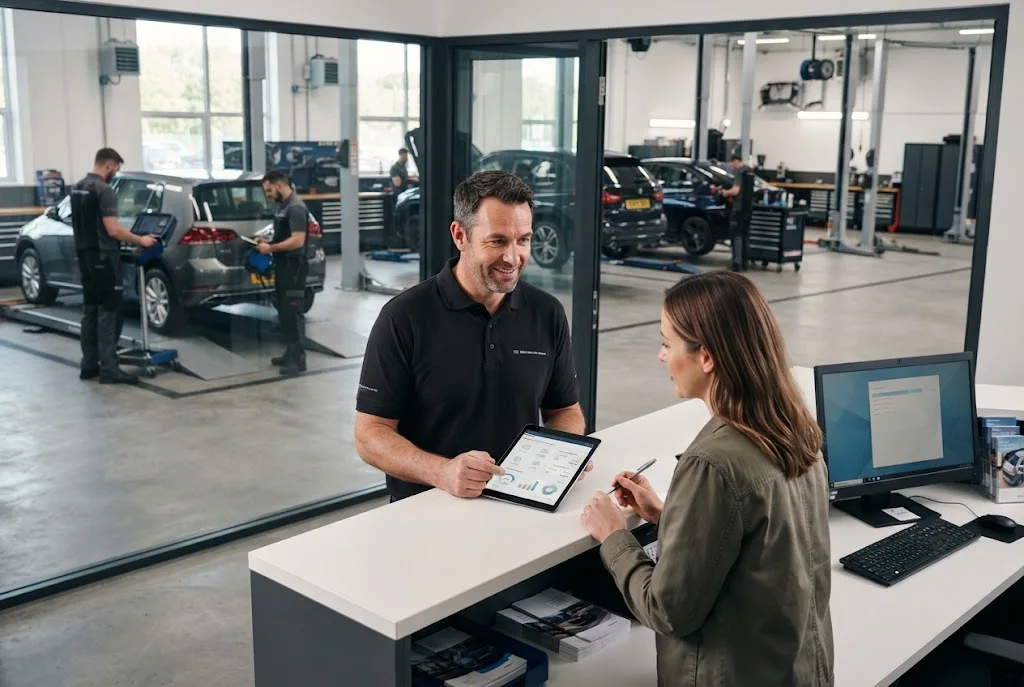
A clear service menu can help. Rather than presenting one unexplained figure, describe what each package includes and identify circumstances that may lead to additional charges.
For example, a routine service package may cover specified inspections, oil and filter replacement and other scheduled maintenance items. Additional repairs or replacement components can then be quoted separately when required.
This approach makes the pricing process easier to understand and reduces the likelihood of disputes caused by customers assuming that every possible repair is included in a headline service price.
Set Different Prices for Different Service Levels
A garage may offer several service levels because vehicles and customers have different maintenance requirements. Creating clearly defined packages can make pricing easier to manage while giving customers a choice.
Interim Service Pricing
An interim service is generally a less comprehensive maintenance visit than a full service. The exact contents should be clearly defined by the workshop so customers know what they are paying for.
When establishing an interim service cost, calculate the expected labour time, included parts and consumables before adding the appropriate contribution towards overheads and profit.
Full Service Cost
A full service normally includes a broader set of checks and maintenance tasks. Consequently, the full service cost should reflect the additional technician time and materials involved.
Providing customers with a checklist of included work can make the price easier to justify and compare. It also gives service advisers a consistent framework when explaining the package.
Major Service Cost
A major service can involve additional maintenance requirements depending on the vehicle, mileage and manufacturer’s recommended schedule. Consequently, the major service cost may vary substantially between vehicles.
Rather than advertising an unrealistically universal price, businesses can explain that major servicing is assessed according to the vehicle’s specific maintenance requirements.
Develop a Workshop Pricing Strategy
A strong pricing strategy should consider both market positioning and business economics. There is no requirement for an independent garage to be the cheapest provider in its area.
Instead, determine what makes the workshop valuable. It could be convenient appointments, experienced technicians, specialist diagnostics, transparent communication, high-quality parts or particularly efficient turnaround times.
Once the value proposition is clear, pricing can be positioned accordingly. A business competing primarily on convenience may use a different model from a specialist workshop that invests heavily in diagnostic equipment and technical training.
Pricing should also be reviewed regularly. Supplier prices, labour costs and operating expenses can change over time. A service that was profitable several years ago may no longer provide the same margin if its underlying costs have increased.
Businesses building their broader operation can also refer to the auto services business strategy guide for a wider view of service mix, operations and growth.
Use Labour Rates Effectively
Labour is one of the most important elements of workshop pricing. An hourly labour rate needs to reflect the cost of employing technicians and maintaining the facility while contributing towards the business’s profit.
However, the advertised hourly rate alone does not determine profitability. The workshop also needs to consider how much of the available technician time is actually productive and billable.
For example, technicians may spend time on vehicle movements, inspections, documentation, cleaning, parts collection or waiting for information. These activities are part of workshop operations even though they may not all generate direct billable labour.
Improving workshop productivity can therefore have a significant effect on profitability without simply increasing the price charged to customers.
Balance Parts Pricing and Customer Value
Parts pricing requires careful management. Customers may compare component prices online, but a workshop provides more than the physical part. It provides diagnosis, sourcing, fitting, testing and responsibility for the completed job.
Businesses should use reliable suppliers and establish clear purchasing processes. Parts should meet the quality and specification appropriate for the vehicle and the work being carried out.
Transparency is important when discussing parts. Where customers have legitimate choices, explaining the available options can help them make an informed decision without reducing the conversation to price alone.
A well-managed parts margin can contribute significantly to overall service profitability, particularly when combined with efficient labour utilisation.
Don’t Compete Only on the Lowest Price
One of the most damaging pricing mistakes for an automotive workshop is attempting to win every customer through the lowest possible price.
Low prices can increase enquiry volume, but they can also create pressure to reduce labour time, use unsuitable parts or cut investment in training and equipment. Over time, this can damage both profitability and reputation.
A better strategy is to communicate value. Explain what the customer receives, use qualified technicians, maintain appropriate equipment and provide clear information about the work.
Customers who understand the service being provided are often in a better position to compare businesses on more than price alone.
Build Pricing Around Service Profitability
Service profitability should be assessed at both job and business level. Individual jobs can have different margins, and not every service needs to produce exactly the same return.
For example, a routine maintenance service may be relatively predictable and help bring customers into the workshop, while diagnostic work or specialist repairs may require more expensive equipment and highly skilled labour.
Track revenue, parts costs, labour time and other relevant expenses for major service categories. Over time, this information can reveal which services contribute strongly to the business and which may need repricing or operational improvement.
Businesses should also pay attention to comeback work. A repair that has to be corrected at the garage’s expense can eliminate much of the margin from the original job and potentially harm customer trust.
Improve Garage Efficiency Before Raising Prices
When margins are under pressure, increasing prices is not always the first solution. Improving workshop efficiency can sometimes produce better results.
Review how vehicles move through the workshop. Identify bottlenecks involving bookings, vehicle inspections, diagnosis, parts ordering, technician allocation and final quality checks.
Better scheduling can reduce periods where technicians are waiting for work. Accurate parts ordering can reduce vehicle downtime. Clear job documentation can prevent technicians from having to repeatedly clarify what work is required.
These improvements can make the existing pricing structure more profitable without necessarily making services more expensive for customers.
For more detailed operational guidance, see the related article on running a high-performance garage.
Communicate Additional Repair Costs Clearly
Unexpected repairs are one of the most sensitive areas of automotive pricing. A customer may bring a vehicle in for routine servicing and then discover that additional work is recommended.
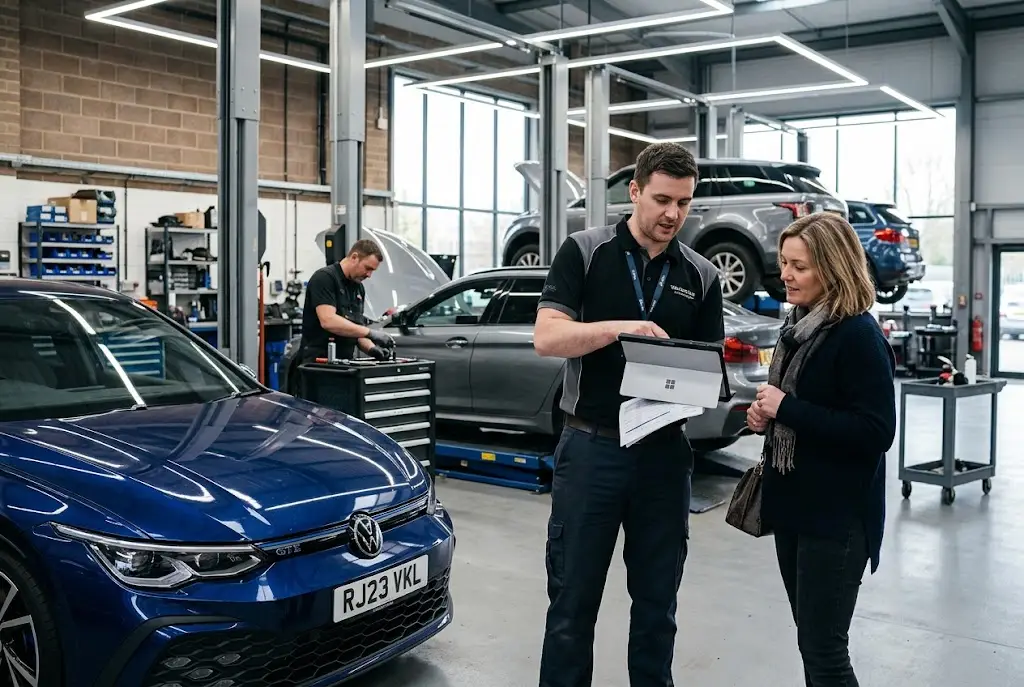
The workshop should explain the issue clearly, distinguish essential concerns from other recommendations where appropriate and provide a realistic estimate before carrying out additional chargeable work.
Good communication reduces surprises and gives customers greater confidence in the workshop’s recommendations.
It can also help service advisers avoid the perception that the business is continually adding unnecessary charges to an original quote.
Review Pricing Regularly
Pricing should not be treated as a decision that is made once and forgotten. Review the business’s pricing structure periodically and compare it with actual operating performance.
Look at supplier costs, technician wages, equipment expenses, workshop utilisation and the profitability of different service categories. If a package consistently takes longer to complete than originally estimated, its price or process may need to change.
Market research can also provide useful context. Competitor prices can help you understand local positioning, but they should not replace your own cost calculations.
The right price is one that customers can reasonably understand and accept while allowing the business to deliver the promised level of service sustainably.
Final Thoughts on Car Service Cost
Managing car service cost effectively is about much more than choosing a number for a price list. A profitable automotive business needs to understand labour, parts, overheads, workshop capacity and customer expectations before deciding what to charge.
Clear service packages can make prices easier for customers to understand, while accurate job costing helps business owners protect margins. At the same time, improving workshop efficiency can increase profitability without relying entirely on higher prices.
The best pricing strategy is ultimately one that supports quality, transparency and long-term sustainability. When a garage delivers dependable work at a clearly explained and commercially sensible price, it can compete on value rather than simply competing to be the cheapest.